Women Farmers Seek Better Security, Finance, Machinery to Boost Niger’s Agricultural Economy.
ABUJA,September 24, 2026.
Small-scale women farmers in Niger State have called for stronger government intervention in security, agricultural financing and access to gender-responsive mechanisation, saying persistent gaps in these areas are limiting their contribution to food production and the wider agricultural economy.
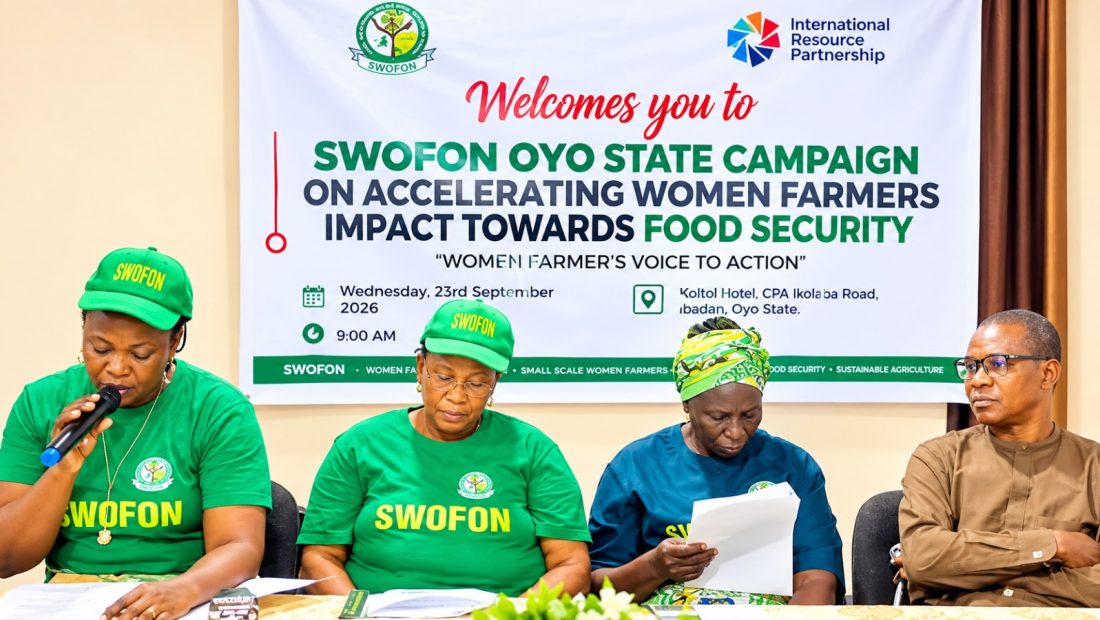
The call was made by the Small-Scale Women Farmers Organisation in Nigeria (SWOFON), Niger State Chapter, during a state-level campaign in Minna focused on accelerating the contribution of women farmers to food security.
The campaign, organised in collaboration with the International Budget Partnership (IBP) and civil society organisations, provided a platform for women farmers to highlight challenges affecting production, processing, marketing and their participation in the agricultural value chain.
SWOFON Niger State Coordinator, Mrs Grace Disa, said women farmers remained important contributors to the state’s food system but continued to face barriers relating to land, finance, farm inputs, mechanisation, markets and security.
According to her, inadequate and delayed budgetary support also affects the ability of women farmers to plan effectively and sustain agricultural activities.
The organisation therefore called for affordable financing models that take into account the seasonal nature of agricultural income and the limited collateral available to many smallholder women farmers.
The women farmers also advocated access to gender-friendly agricultural machinery, improved storage and processing infrastructure, stronger market linkages and better security around farming communities.
SWOFON further urged the government to strengthen storage capacity, including silos, as part of efforts to reduce post-harvest losses and improve the preservation and marketability of agricultural produce.
The organisation also called for the timely provision of fertiliser, improved seeds and other farm inputs before the commencement of farming seasons, stressing that predictable access to inputs is essential for improving productivity.
Presenting the organisation’s policy recommendations, Mrs Hannah Omuya, State Secretary of SWOFON Niger, advocated greater investment in processing facilities and climate-smart agriculture to enable women farmers to move beyond primary production and participate more effectively in higher-value segments of the agricultural chain.
She also stressed the need for stronger security measures to enable farmers to access their farms safely and protect their produce.
Responding on behalf of the Niger State Ministry of Agriculture, the Permanent Secretary, Mr Matthew Ahmed, said women constitute more than 60 per cent of the state’s agricultural workforce.
He said the government recognised the challenges confronting women farmers, including access to land, agricultural inputs, finance, extension services, mechanisation, storage and markets.
Ahmed, represented by the Director of Agriculture Linkages and Services, Mr Garba Maikasuwa, said the state government had established the Agricultural Cooperatives Micro Credit Agency, with women allocated 60 per cent of its credit facility.
The ministry also expressed its readiness to continue working with SWOFON and other stakeholders to address constraints affecting women farmers.
Business and Investment Implications
For the business community, the issues raised by the women farmers point to significant opportunities across Niger State’s agricultural value chain.
Improved access to finance and mechanisation could increase production capacity, while investments in storage and processing could reduce post-harvest losses and create opportunities for value addition.
Stronger market linkages could also connect women-led agricultural enterprises with processors, distributors, retailers and larger institutional buyers, potentially expanding commercial activity beyond primary farming.
For investors and financial institutions, the campaign highlights the importance of developing agricultural finance products that reflect the seasonal cash flows of farming businesses, rather than relying solely on conventional lending conditions.
The call for gender-responsive machinery also presents an opportunity for equipment suppliers, cooperatives and agribusiness investors to develop machinery and service models that are affordable and accessible to smallholder farmers.
The development of stronger storage, processing and market infrastructure could consequently support greater participation of women in agribusiness while contributing to food supply, rural livelihoods and local economic activity.
What Investors and Agribusiness Stakeholders Need to Know
- Finance: Women farmers are seeking agricultural credit designed around seasonal farm income and limited collateral.
- Mechanisation: There is demand for affordable, gender-responsive agricultural machinery and services.
- Storage: Better storage infrastructure could reduce post-harvest losses and support more stable supply.
- Processing: Investment in processing could enable women farmers to participate in higher-value agricultural activities.
- Market access: Stronger connections between producers, processors and buyers could expand commercial opportunities.
- Climate resilience: Climate-smart agricultural support is increasingly important for sustainable production.
- Security: Safe access to farms remains essential to agricultural productivity and investment.
The campaign reflects a broader national push by SWOFON to move from advocacy and participation in budget processes towards concrete government commitments, implementation and measurable support for smallholder women farmers. Recent reporting on the organisation’s wider national campaign shows that women farmers are also seeking stronger accountability in agricultural budgeting and improved delivery of services and infrastructure.
Source: News Agency of Nigeria (NAN)