
Ringo Star and the Children of Surulere
How a flamboyant photographer on a decorated bicycle turned an ordinary Lagos afternoon into a carnival, and quietly gave a generation of children something to remember
BY ADESOJI ADESUGBA
Some photographs record what we looked like. Others, without warning, hand an entire world back to us.
More than half a century after it was taken, I recently came across an old black-and-white photograph of myself. A young boy in a short-sleeved white shirt tucked neatly into his trousers, standing beside the luxuriant garden plants that grew around almost every home in those days. It was a picture I must have seen many times without pausing over it.
Then I turned it over. On the back was a faded purple stamp:
PATRONIZE
CHIEF CAMERA-MAN
AFRO RINGO STAR PHOTOS
8 MAY 1972
72, OJUELEGBA RD., SURULERE
Afro Ringo Star.
Suddenly the photograph was no longer a picture of a boy from 1972. A bell began ringing somewhere in my memory. Then came the sound of a horn. And, just like that, I was a child again, running through the streets of Surulere behind the most extraordinary photographer Lagos ever gave us.
From Isale Eko to a New Lagos
Our journey to Surulere had begun years earlier, when my family moved from 18 Idoluwo Street, Isale Eko, on Lagos Island, to Modupe Johnson Crescent. For a child, it must have felt like crossing between two different worlds.
Isale Eko was old Lagos: established, crowded, intimate, and thick with the memory of generations. Surulere was something else entirely. It was new. The story behind that newness, though I could not have known it as a boy, reached back to a colonial clearance scheme: after the bubonic plague of the late 1920s, the Lagos Executive Development Board was created to reshape the mainland, and the model suburb of Surulere was laid out in part to rehouse families displaced from the crowded island. “Surulere” itself is Yoruba for a proverb of endurance, that patience is rewarded.
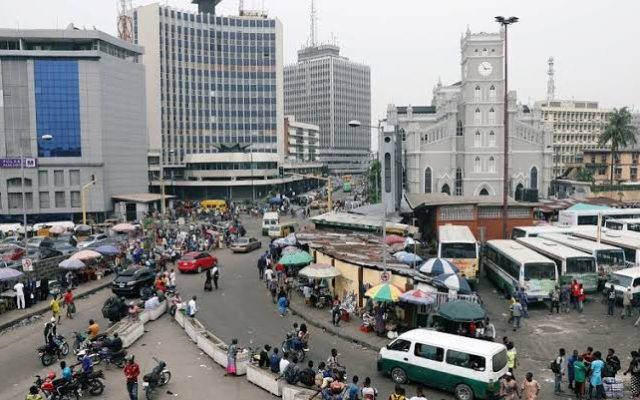
By the time I knew it, much of what surrounded us seemed freshly made. The roads were new. Houses were springing up. Schools were being established. There were markets, sports clubs, a cinema, a shopping centre. Everywhere was the evidence of a city striding into its own future. People called it New Lagos, and it truly felt new.
The Surulere of my childhood bore little resemblance to the congested, intensely commercial district of today. There were still relatively few cars, so the newly tarred roads could stand almost empty, and for children those streets became an extension of our homes. We played on them. We ran across them. We explored them.
Because most houses had no high perimeter walls, the whole neighbourhood had an openness that is hard to imagine now. You could see into your neighbour’s compound. Children wandered between houses. Parents knew one another’s children. Most families kept a garden in front and a small vegetable patch behind. There was pipe-borne water. Open gutters ran along the streets, and every household was expected to keep its stretch clean.
And then there were the health inspectors. Their visits were never announced; they simply appeared. People took sanitation seriously because the regulations were taken seriously, and there was little sense that an erring household could negotiate its way out of trouble. So compounds were swept, gutters were cleared, and families kept their surroundings. It was, quite simply, a different civic culture.
When the Bus Had a Timetable
Public transport is another memory of that Lagos. The bus service was regular and efficient, and it ran to a timetable. The first buses pulled out around six in the morning from the Shell Club Bus Terminal on Adeniran Ogunsanya Street, opposite the Shell Club itself.
The Shell Club was one of those landmarks around which neighbourhood life revolved. It was a sports and social club, yes, but also a gathering place where events were held, families met, and children grew up knowing it as part of the geography of Surulere. Adeniran Ogunsanya was otherwise a residential street, a young suburb of young families. Many of the fathers were civil servants or professionals building careers in a newly independent country; their wives were raising children, working, trading, and building enterprises of their own.
And everywhere there were children. Lots of children. We went to schools within the neighbourhood, played football in whatever space we could find, invented games, and knew every shortcut between the streets, able to vanish from one compound and surface from another. The absence of high walls meant that childhood itself seemed to have fewer walls.
It was into this Surulere that Afro Ringo Star rode his bicycle.
Then We Heard the Horn
I must have been about eight when I first encountered him. You usually heard him before you saw him.
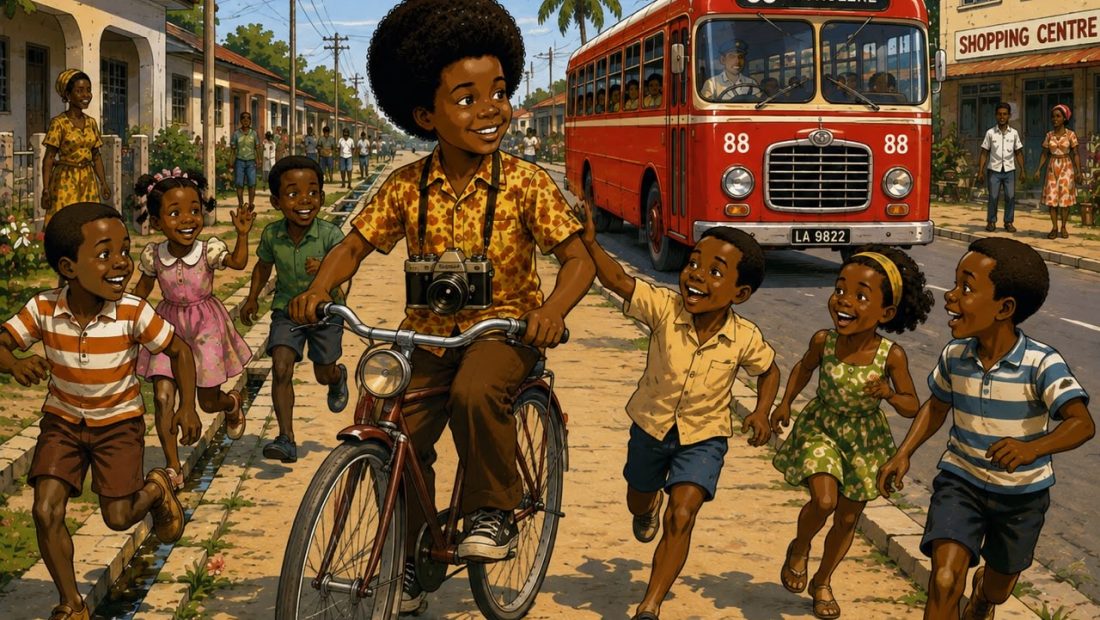
Ring! Ring! Ring! The unmistakable bell. Then that peculiar horn, nothing like the ordinary bicycles that occasionally passed through. This horn announced somebody. And every child knew who.
Afro Ringo Star!
Whatever you were doing stopped. A game abandoned halfway. A conversation forgotten. Children poured from compounds and houses toward the road, and there he would be, riding slowly along one of those broad, empty streets on the most magnificent bicycle our young eyes had ever seen. At least, that is how I remember it: decorated, colourful, impossible to ignore.
On it sat Afro Ringo Star, flamboyantly dressed and, in my child’s recollection, styled after the international pop star Ringo Starr of The Beatles, whose own quieter secret, we would only learn much later, was a lifelong love of photography. To us, the man on the bicycle was not merely a photographer. He was a performer. An entertainer. A moving carnival. And, most importantly, he belonged to the children.
The Pied Piper of Surulere
Looking back now, the image that comes closest is Robert Browning’s Pied Piper of Hamelin. But this was no sinister piper luring children away. This was our own African Pied Piper, riding through Surulere with a camera somewhere in his professional life, a bell on his handlebars, and half the neighbourhood running behind him.
The procession grew as it moved from street to street. Five children became ten. Ten became twenty. Some tired and fell away; new ones heard the commotion and joined. And through all of it ran the song, or, more accurately, a never-ending conversation between Ringo Star and the children of Surulere.
We called out:
“Ringo Star!” /
He answered:
“Wa délé!” / You will get home.
And immediately we challenged him:
“Tó bá délé ńkọ́?” / And what if you don’t get home?
Ringo fired back:
“Wa sùn ita!” / You will sleep outside.
And we shouted:
“Tó bá sùn ita ńkọ́?” / And what if you don’t sleep outside?
And on it went. Question. Answer. Another question. Another answer. Ringo Star always seemed to have something to say. The object was never to reach an end. There was no end. The fun was in keeping the exchange alive. A child would find another impossible question; Ringo would find another ridiculous answer; and the whole procession would erupt in laughter as we ran behind the bicycle.
Years later I discovered something remarkable. Other children remembered exactly the same thing. The writer Dapo Thomas, recalling his own Surulere childhood, described hearing that same air horn, rushing outside, and joining the children behind the photographer on his decorated bicycle, down to the very same Yoruba call-and-response. So it wasn’t something my imagination had enlarged with the years. It happened. We were there.
A Marketing Genius Before We Had the Word for It
Only as an adult do I understand what Afro Ringo Star was actually doing. He was marketing, and brilliantly so. Long before anyone around us said “personal branding,” “experiential marketing,” or “customer activation,” this photographer had grasped all of it by instinct.
His bicycle was his billboard. His clothes were his logo. His horn was his advertising jingle. The streets were his media platform. And we, the children of Surulere, were his unpaid brand ambassadors.
What an ingenious strategy it was. Every child knew Ringo Star. Every child talked about Ringo Star. And therefore every household with children knew Ringo Star. So when a birthday came, when a family celebrated, when someone wanted a portrait or an occasion preserved, which photographer did the children clamour for? Ringo Star. He had converted childhood affection into brand recognition. We thought we were chasing him. In truth, he was building a business.
The Photographer Behind the Performer
Researching him now reveals another Afro Ringo Star, one we children could not have appreciated. The man on the bicycle was also a serious professional, remembered as a popular Lagos Mainland photographer from the late 1960s into the 1980s, working weddings, birthdays, burials, passport portraits, celebrities, and prominent Lagosians.
Then his camera entered another great arena of Nigerian life: football. This was the golden age of the domestic game, when clubs like Stationery Stores of Lagos and Shooting Stars of Ibadan commanded fierce loyalty, and when a homegrown generation was breaking into the national side and, in 1980, would lift Nigeria’s first Africa Cup of Nations. Afro Ringo Star was reportedly associated with some of the era’s best-known clubs: Stationery Stores, Calabar Rovers, NEPA, National Bank, Leventis United, New Nigeria Bank and others.
His lens is said to have captured the great names of that period: Segun Odegbami, Mudashiru “Muda” Lawal, Christian Chukwu, Emmanuel Okala, Best Ogedegbe, Haruna Ilerika, Peter Fregene, Henry Nwosu, Godwin Odiye. Ilerika, fittingly, had first made his name leading a Surulere secondary school to the Principals’ Cup before joining Stores. That mischievous Pied Piper the children chased through our streets was, whether he knew the weight of it or not, quietly becoming a recorder of Nigerian sporting history.
And perhaps that is both the tragedy and the beauty of photographers: they preserve everyone else’s history while often leaving too little of their own.
8 May 1972
Which brings me back to the photograph in my hand. There I am. A boy. The world is ahead of him. He cannot know where he will travel, what work he will do, whom he will meet, or the chapters that will one day make up his life. He certainly cannot imagine that, more than half a century later, he will turn the picture over, find a faded stamp, and unlock an entire room in his memory.
AFRO RINGO STAR PHOTOS.
And suddenly I remember the horn. The bell. The bicycle. Children pouring into the streets. Surulere.
There is something else that makes the photograph deeply personal. Afro Ringo Star helped awaken my interest in photography, a hobby that has stayed with me my whole adult life. I have carried cameras, studied images, and come to appreciate the peculiar power of a photograph to hold onto something time is otherwise determined to take. Until I rediscovered this picture, I had never fully connected that lifelong interest with the flamboyant man on the bicycle who so fascinated me as a child. Perhaps some seeds are planted so quietly that we notice them only after they have become trees.
Before the Walls Went Up
When I look back at the Surulere of the 1960s and early 1970s, I realise I am remembering far more than streets and buildings. I am remembering a particular idea of community.
The houses needed no fortress walls. A child could run behind a strange but beloved photographer from street to street and still, somehow, find his way home. Neighbours knew one another. The garden in front of your house added to the beauty of the whole street. Keeping the gutter clean was at once a private duty and a public one. The bus kept its timetable. The health inspector might arrive without warning. And one eccentric photographer could turn an ordinary afternoon into a carnival simply by ringing a bell as he rode down the road.
Then Lagos grew. Surulere grew. Cars multiplied. Quiet streets became busy roads. Gardens vanished beneath concrete. Walls rose between the houses; gates climbed higher. The little suburb that once felt like a giant playground became part of one of the largest, busiest cities in Africa. And, inevitably, childhood ended too.
But memory keeps its own geography. There are streets within us that no developer can redevelop, houses that cannot be demolished, sounds that traffic cannot drown. Somewhere in that inner Surulere the roads are still freshly tarred. The gutters are clean. The gardens have no walls between them. The morning bus is keeping to its timetable. Children are playing outside.
And then, faintly in the distance, a sound. Ring! Ring! Ring! A funny horn follows. A child stops playing. Another runs from the next compound. Doors open. Children appear from everywhere. And around the corner comes a colourful bicycle.
“RINGO STAR!”
“WA DÉLÉ!”
And within moments we are all running again. Running behind Afro Ringo Star. Running through the empty streets of Surulere, through a Lagos that no longer exists except in our photographs and our memories.
And this time, more than fifty years later, I understand what the photographer had been doing all along. Afro Ringo Star was taking our pictures. But without ever knowing it, he was also giving us something to remember.
About the Writer
Professor Adesoji Adesugba is a Nigerian investment-promotion and economic-development specialist, lawyer and academic, and a former Managing Director of the Nigeria Export Processing Zones Authority (NEPZA). Raised in Surulere in the 1960s and 1970s, he is the founder and President of the Gemological Institute of Nigeria and a lifelong photography enthusiast whose interest, as this essay recounts, was first sparked by a flamboyant neighbourhood cameraman on a decorated bicycle.